
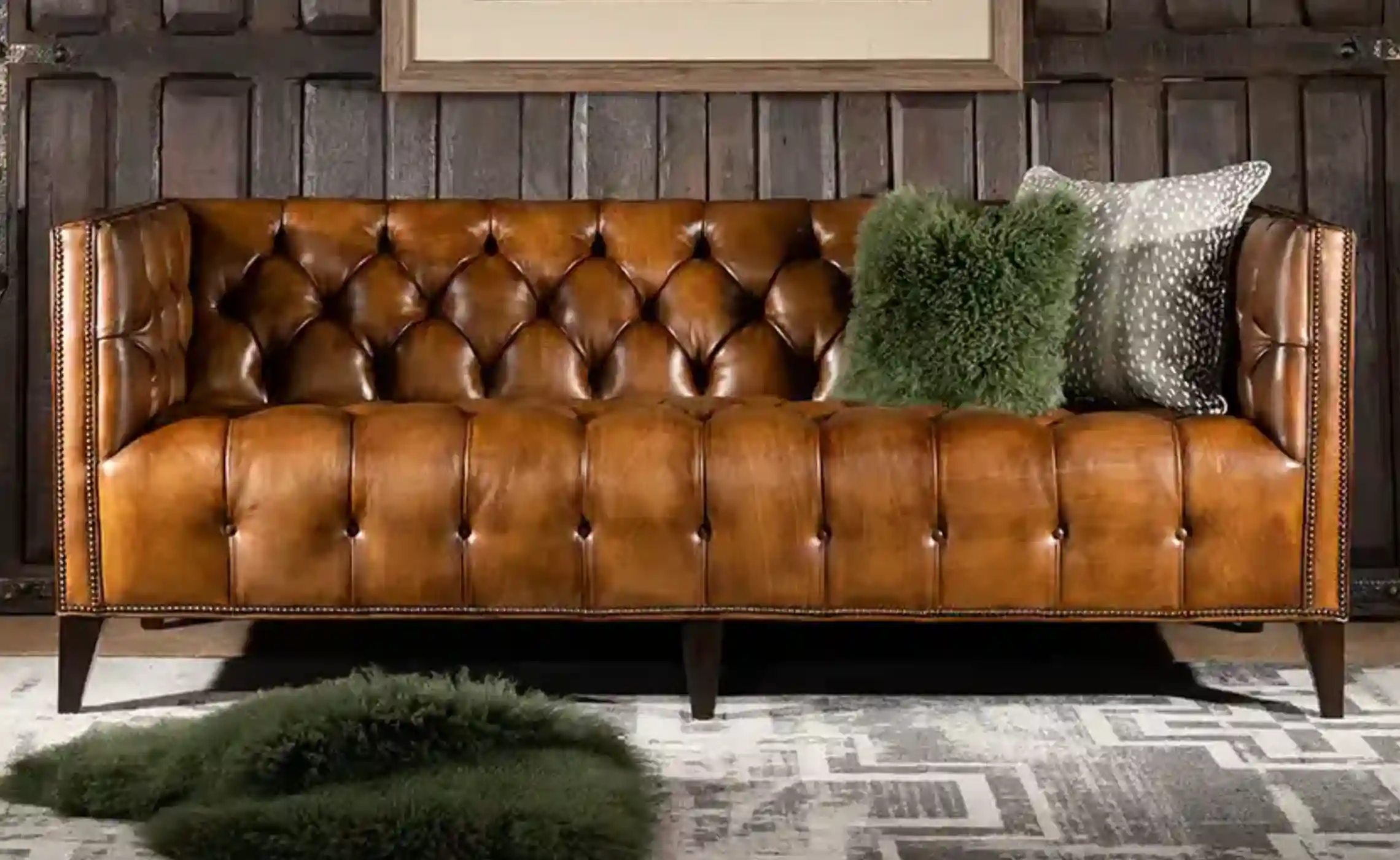
This guide breaks down where manufacturers and retailers typically cut costs, so buyers can judge whether the compromise suits their home, lifestyle, and budget.
What does “cheap” usually mean for leather sofas in Australia?
It usually means the sofa has been built to hit a price point rather than a long lifespan. Cheap leather sofas are commonly sold through online-only retailers, clearance warehouses, and big-box promotions with limited customisation.
In many cases, the “leather” is real in some places and synthetic in others. That mix can still work, but it changes how the sofa wears, feels, and ages in Australian conditions.
Is the leather itself where most of the savings come from?
Yes, the biggest cost lever is often the leather selection and how it is processed. Cheap leather sofas may use thinner hides, corrected-grain leather, split leather, or leather match instead of higher-grade full-grain.
These options reduce material costs and improve consistency in appearance. The trade-off is typically less natural character, lower breathability, and a finish that can show wear sooner, especially in high-use family rooms.
Are “leather match” and “genuine leather” labels used to lower the price?
Often, yes. “Genuine leather” is a broad label that does not guarantee top-tier hide quality, and leather match commonly means real leather on contact areas and vinyl or PU on the sides and back.
Cheap leather sofas using leather match can still make sense for renters or low-traffic rooms. The key is that buyers know exactly which panels are leather and which are not before ordering.
Does the tanning and finishing process affect price and durability?
Yes, finishing is one of the easiest ways to control cost and appearance. Cheaper production tends to favour heavily pigmented finishes that hide scars and colour variation.
That uniform look is popular in many Australian homes because it suits modern interiors. The downside is that thick topcoats can feel less supple and may crack or peel if the coating quality is low and the sofa sits near sunny windows.
Do cheap options save money by using thinner leather or split hides?
Often, yes. Thinner leather can lower production costs and make upholstery easier to stretch over a frame, while split leather comes from the lower layers of the hide rather than the stronger top-grain section. Split leather sofas can therefore offer a more affordable alternative, although durability and finish depend heavily on the specific construction.
Cheap leather sofas built this way can be comfortable at first. Over time, they may show stretching, surface wear, or a “drier” look, particularly in homes with pets, kids, or heavy daily use.
Is the frame where manufacturers cut costs?
Yes, the internal frame is another major source of savings. Budget frames may use softwood, particleboard, MDF components, or fewer corner blocks and braces.
In Australia, these frames can hold up in light use, but they are more likely to loosen, creak, or rack over time. A stronger hardwood or kiln-dried frame costs more because it uses better timber and more reinforcement.
Do cheaper sofas use different suspension systems?
Yes, and it matters. Many cheaper builds use basic webbing or lighter-gauge springs instead of heavier sinuous springs, eight-way hand-tied springs, or upgraded combinations.
Affordable leather sofas with basic webbing can still work well in guest rooms or spaces used occasionally. However, for a main living area, leather lounge suspension deserves closer attention because the quality of the support system can influence comfort and how quickly the seating develops noticeable sagging.
Is foam quality a big factor in the lower price?
Yes, seat foam density and resilience are common cost-cutting points. Lower-density foam costs less, feels soft in the showroom, and helps hit promotional price tags.
The trade-off is faster compression and a “bottoming out” feel after months or a few years. Cheap leather sofas can be good value when the foam is at least mid-grade and the seat design allows easy cushion rotation.
Do cheaper cushions skip layers like feather or latex?
Often, yes. Higher-end cushions may combine foam cores with latex, memory foam, feather wraps, or fibre layering to improve comfort and recovery.
Budget cushions tend to be simpler, using a single foam grade with minimal wrap. That approach reduces cost and maintenance, but it can feel flatter over time, especially for households that use the sofa every night.
Are stitching and tailoring simplified to reduce labour costs?
Yes, labour is expensive, so tailoring is an easy place to simplify. Some cheaper pieces use fewer seams, less complex panel shapes, and faster stitching methods.
Cheap leather sofas may also use thicker thread and wider stitch spacing to speed production. These choices are not always “bad,” but they can reduce the refined look and may affect how well covers hold shape at corners and high-stress areas.
Do reclining mechanisms and add-ons change where the savings come from?
Yes, mechanisms can swing the build cost dramatically. When a recliner sofa is cheap, savings may come from lighter mechanisms, fewer metal supports, simpler motor assemblies, or limited warranty coverage.
Cheap leather sofas with electric recliners can still suit many Australian households. It is worth checking weight ratings, expected cycles, and whether the retailer stocks parts locally.
Are cheap leather sofas cheaper because they are imported at scale?
Yes, scale is a major reason prices drop. Large import runs allow factories to buy hides, foam, and frames in bulk and standardise patterns to reduce waste.
This is one reason cheap leather sofas can look surprisingly good for the price in Australia. The trade-off is less control over consistency, fewer custom options, and sometimes slower support if issues arise.
Do warehouse models and online-only sellers cut out showroom costs?
Yes, and those savings can be real. Showrooms, sales commissions, and high-rent retail locations add cost, so online-only operations and warehouses can undercut traditional stores.
Cheap leather sofas sold this way can be a smart buy if the return policy is clear. Buyers should check who pays return freight within Australia and whether the item is assessed as “change of mind” or “fault.”
Are warranties and after-sales support reduced to keep prices low?
Often, yes. Shorter warranties, narrower coverage, and stricter exclusions lower the retailer’s risk and allow a lower ticket price.
Cheap leather sofas may come with limited cover on leather, foam, and mechanisms. If a household expects heavy daily use, stronger warranty terms can matter as much as the initial price.
Does “flat-pack” or quick assembly reduce the total cost?
Sometimes, yes. Designs that ship in fewer cartons, use bolt-on arms, or rely on simple assembly can reduce freight costs and warehouse handling.
In Australia, shipping is a big part of furniture pricing, especially to regional areas. Cheap leather sofas may be cheaper partly because they are optimised for transport, not because the visible materials are dramatically worse.
Can delivery pricing hide where the savings really are?
Yes, and it can go both ways. Some retailers discount the sofa but charge higher metro delivery, stair carry fees, or regional surcharges.
Cheap leather sofas might look like a bargain until checkout. Buyers can compare “delivered price” across Sydney, Melbourne, Brisbane, Perth, Adelaide, Hobart, Canberra, and key regional routes to see the real difference.
Are floor stock, seconds, and clearance deals a safer kind of “cheap”?
Often, yes, because the build may be better than the price suggests. Clearance can reflect discontinued colours, changed model names, cancelled orders, or minor cosmetic marks.
Cheap leather sofas bought as floor stock let buyers inspect the exact piece and judge softness, creasing, and comfort. They should still confirm warranty status, as some clearance items have modified terms.
What should buyers check before trusting a low price?
They should check the leather type on each panel, the frame material, suspension, and foam specs. If the retailer cannot provide details, the low price may involve more compromises than expected.
For cheap leather sofas, a practical checklist includes: leather match disclosure, seat foam density, frame construction method, warranty length, and return freight rules within Australia.
When are cheap leather sofas actually a good purchase?
They are often a good purchase for low-traffic rooms, short-term homes, rentals, or buyers who prefer replacing furniture every few years. In those cases, the lower upfront cost can beat paying for features they will not fully use.
Cheap leather sofas can also suit households that prioritise a leather look with easy wipe-down care. The best outcomes usually come from choosing a simpler design and avoiding the lowest-grade coatings.
What is the simplest way to balance savings and longevity?
They should spend where wear is highest and save where it is not. That usually means prioritising better contact leather, stronger seat support, and higher-density foam, while keeping the design simple.
Cheap leather sofas can be a smart Australian buy when the savings come from efficient manufacturing and standardised retailing rather than compromised construction. Buyers should still look for solid frames, suitable upholstery, and properly supported seating to ensure the lower price does not come from weak materials or underbuilt components.
FAQs (Frequently Asked Questions)
What does “cheap” usually mean for leather sofas in Australia?
In Australia, “cheap” leather sofas typically refer to pieces built to meet a lower price point rather than designed for long-term durability. These sofas are often sold through online-only retailers, clearance warehouses, or big-box promotions with limited customization. The leather used may be a combination of real and synthetic materials, affecting how the sofa wears and ages in Australian conditions.
Where do manufacturers cut costs on cheap leather sofas?
Manufacturers often reduce costs by using lower-quality hides such as thinner hides, corrected-grain, split leather, or leather match instead of premium full-grain leather. They also economize on the internal frame by using softer woods or particleboard, simpler suspension systems like basic webbing instead of hand-tied springs, lower-density foam cushions, simplified stitching and tailoring, and lighter or less robust reclining mechanisms.
What is “leather match” and how does it affect sofa quality?
Leather match refers to sofas that have real leather only on contact areas like the seat and back cushions, while sides and backs are covered with vinyl or polyurethane (PU). This approach lowers production costs but changes the sofa’s feel and durability. Leather match sofas can still be suitable for renters or low-traffic rooms if buyers understand exactly which parts are genuine leather.
How does the tanning and finishing process impact cheap leather sofas?
Cheaper leather sofas often use heavily pigmented finishes to hide scars and color variations, resulting in a uniform look popular in modern Australian homes. However, these thick topcoats can feel less supple and may crack or peel over time, especially if exposed to sunlight near windows. The finishing process plays a significant role in both cost control and the sofa’s long-term appearance.
Are cheaper cushions on leather sofas less comfortable?
Yes, budget cushions usually use lower-density foam without additional layers like feather wraps or latex that provide enhanced comfort and recovery. While these simpler cushions reduce cost and maintenance needs, they tend to flatten over time—particularly in households with daily sofa use—resulting in faster compression and reduced seating comfort.
Do cheaper frames affect the longevity of leather sofas?
Absolutely. Cheap leather sofas often have frames made from softwood, particleboard, or MDF with fewer reinforcements like corner blocks or braces. While these frames may hold up under light use typical in many Australian homes, they are more prone to loosening, creaking, or warping over time compared to sturdier hardwood or kiln-dried frames used in higher-end models.